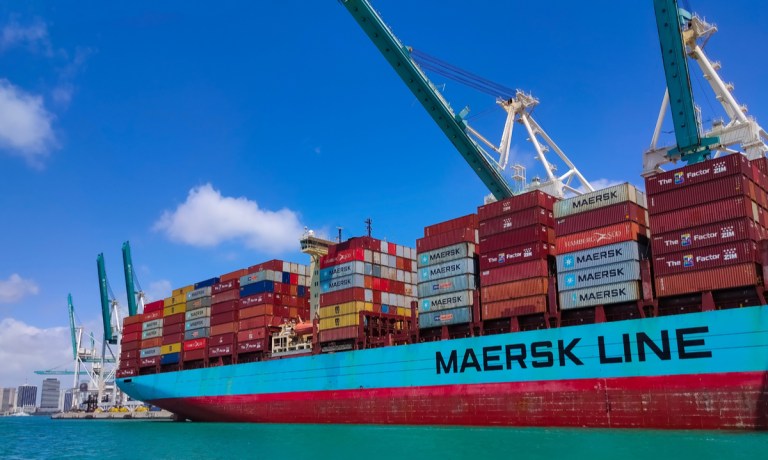
The company, widely considered the bellwether of global trade, released a report Thursday (Nov. 6) showing quarterly earnings before interest, tax, depreciation and amortization (EBITDA) of $2.68 billion.
As a report by CNBC noted, that’s higher than the $2.6 billion forecast by analysts, but still down significantly from the $4.8 billion Maersk recorded the same period last year. The Danish company also raised its full-year operating profit forecast to between $9 billion and $9.5 billion, compared to an earlier guidance of $8 billion to $9.5 billion.
“I think what allowed us to raise the guidance was really a story of resilience,” Maersk CEO Vincent Clerc said in an interview with CNBC’s “Squawk Box Europe.”
“Resilience of demand across all geographies with, towards the end of the quarter, even the U.S. picking up again as we move towards the seasonal year-end peak,” Clerc added.
“And resilience also in our operations where despite a lot of inflationary pressure and a lot of uncertainty, we’ve been able to trim costs and keep our costs under control and thus lift margins across all of the businesses.”
Advertisement: Scroll to Continue
In other tariff-related news, PYMNTS wrote this week about the importance of procurement mapping in the face of ongoing trade tensions.
“Trade flow disruptions are impacting firms across sectors, and CFOs can no longer afford to treat procurement mapping purely as documentation,” that report said. “Instead, they must work to use the exercise to stress-test exposures and harden operations against shocks.”
A “mapped, traceable supply chain” lets companies model the cost of disruptions, evaluate near-shoring opportunities and quantify working capital locked in delays or safety stock, PYMNTS wrote.
“It also allows finance leaders to reduce risk premiums associated with volatile regions or non-compliant partners,” the report continued.
For finance chiefs juggling cost, risk and liquidity, mapping presents a starting point, offering the data foundation needed to view procurement as a path to operational resilience.
“There’s a continuous evolution and … dynamic disruption in finance that requires CFOs to harness data and AI to make finance more efficient, more effective and substantially more strategic,” Mastercard Chief Commercial Payments Officer Raj Seshadri told PYMNTS during a discussion last month for the B2B PYMNTS 2025 event, “B2B.AI: The Architecture of Intelligent Money Movement.”